Riparian habitat and catchment soils
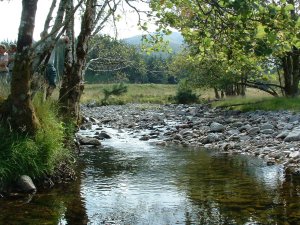
The roots of alder trees strengthen stream banks and their leaves provide food for invertebrate larvae in the river
The health of riparian (stream side) habitat and river catchment areas affects the stability of rivers, their fertility and food availability, and their ability to resist acid flushes. Across much of Wester Ross, soils are thin, peaty, or poorly developed, reflecting an impoverished ecosystem. Indicators of healthy, fertile, soils include earthworms and moles. WRFT is currently mapping the distribution of these, and of invasive New Zealand flatworms.
One of the most exciting developments in recent years has been establishment of Woodland Grant Schemes to restore native woodlands. By reducing grazing pressures (there are still voles and hares in some WGS schemes), planting trees and applying fertilizer, soils are given a chance to recover. The largest WGS in Scotland, the Baile mor woodland established by Gairloch Estate, is located between Gairloch and Loch Maree. There are trout lochs in the new woodland and these may become more productive as the trees become established.
Related Downloads
To download a file, right-click over it's name and choose Save Link/Target As...
-
Wester Ross Fisheries Management Plan 2023 - 2028
This interactive plan provides information about pressures affecting wild salmon and sea trout populations in the Wester Ross area, and proposes a series of actions required to protect, support and strengthen wild fish populations in the Wester Ross area. Comments are welcome, please contact the WRFT Biologist at info@wrft.org.uk . Posted: 05/04/2024 (372KB) -
Juvenile salmon production and nutrition in Wester Ross 2023
This report summarises the results of the juvenile salmon survey in Wester Ross in summer and early autumn, 2023. The report focusses on contrasting the size and biomass of juvenile salmon at different sites. There was much variation in growth; some sites had high densities of larger parr; at other sites parr were small and thin. Important missing food items for parr at some sites may include caddis fly larvae, terrestrial insects, and surplus washed-out salmon eggs which in some rivers may have been of crucial importance for pre-smolt salmon parr. Is it time to provide supplementary food for juvenile salmon in some rivers? . Posted: 05/02/2024 (1.65MB) -
Leave the land better than we found it discussion notes 26 April 2023
Notes from discussion group on theme of 'how do we leave the land better than we found it?' at the Catchment Vegetation Workshop at Kinlochewe on 26th April 2023 . Posted: 02/05/2023 (219KB) -
Mycorrhiza discussion group notes 26 April 2023
Notes from mycorrhiza discussion group at Catchment Vegetation Workshop at Kinlochewe on on 26th April 2023 . Posted: 02/05/2023 (332KB) -
Rough guide to deer stalking by Alasdair Macdonald
This presentation by Alasdair Macdonald of Dundonnell estate discusses deer stalking and explains why some red deer carcasses may be left on the hill. Animals which are in poor condition and not fit for human consumption may be left on the hill for nutrient to be recycled. Bones and antlers are rich in valuable nutrients so best left on the hill. However once taken off the hill, regulations restrict the return of bones back on to the hill. . Posted: 02/05/2023 (1.26MB) -
Glen Torridon Partnership: a landscape-scale Nature Restoration Project by Malcolm Turner
Presentation by Malcolm Turner, of the Woodland Trust, about a pioneering landscape-scale approach to long term habitat restoration in the Glen Torridon area, using nature-based solutions with neighbouring landowners and local communities to create habitats that are resilient to climate change and where biodiversity can flourish. Issues include the need to protect and restore fragments of rainforest, including spread of invasive Rhododendron ponticum, monitoring or red deer and prevention of wild fires. Presented at Catchment Vegetation workshop, Kinlochewe 26th April 2023. Posted: 02/05/2023 (3.20MB) -
Affric Highland Initiative by Paul Greaves
Presentation by Paul Greaves from Trees for Life about 30-year project to scale up nature restoration for the future in support of local communities and businesses. With much background information describing the project area, the objectives, the people with whom the project works and the ways in which trees can be incorporated into the landscape with support from Trees for Life. Presented at Catchment Vegetation workshop, Kinlochewe 26th April 2023 . Posted: 02/05/2023 (9.08MB) -
WRFT Newsletter March 2022
This newsletter provides a summary of some of the work of WRFT over 2021, including some plans for 2022. Posted: 11/03/2022 (2.95MB) -
Nutrient Additions workshop presentation 6th February 2020
Presentation given by Peter Cunningham at the nutrient additions workshop at the Marine Scotland Freshwater laboratory on 6th February 2020. The presentation makes a case for phosphorus budgeting for Wester Ross to restore wild salmon populations and address problems associated with loss of phosphorus transfer and ecosystem malnourishment. . Posted: 28/02/2020 (9.55MB) -
Skye and Wester Ross Fisheries Trust Review February 2018
This review summarises the work of the Skye and Wester Ross Fisheries Trust during the period June 2016 to December 2018. Posted: 06/02/2018 (7.46MB) -
Refertilising Wester Ross 7-9 April 2016 programme
Programme for three-day meeting to review issues relating to the fertility and productivity of land and freshwaters in Wester Ross, including speakers for the workshop on Friday 8th April in the Gairloch Community Hall. Posted: 28/03/2016 (810KB) -
Billier, Geoffrey (2014) A study of macro-invertebrates and the feeding behaviour of juvenile salmon in the Little Gruinard River SAC, 2014
Geoffrey Billier sampled macro-invertebrates and investigate the feeding behaviour of juvenile salmon in the Little Gruinard river, during a three-month internship for WRFT, as part of his studies at Ecole Nationale Sup?rieure Agronomique de Toulouse 'ENSAT'. This report provides much new information about the biodiversity of macro-invertebrates in the river, drift patterns (day & night) and the diet of salmon fry, parr and smolts. Posted: 30/09/2014 (3.22MB) -
Ullapool River Fisheries Management Plan 2006-2010
This report published in March 2006 provides an outline of the following: catches of salmon and trout in the Ullapool Rivr, results of juvenile salmon and trout surveys within the catchment, an assessment of the freshwater habitat accessible to salmon and sea trout; management recommendations and options to restore the natural fisheries productivity of the Ullapool River system. Posted: 11/09/2012 (4.62MB) -
Refertilising Scotland part 2
Part 2 of presentation given by Peter Cunningham at the Reforesting Scotland Annual meeting at Torridon Village Hall on 25th September 2010. Posted: 27/09/2010 (15.03MB) -
Refertilising Scotland part 1
Part 1 of presentation given by Peter Cunningham at Reforesting Scotland Annual meeting at Torridon Village Hall on 25th September 2010. Posted: 27/09/2010 (25.99MB) -
Improving Habitats for Salmon and Trout Production in Wester Ross
PDF version of presenation by Peter Cunningham (WRFT Biologist) at WRFT-FWAG workshop on 26th January 2009. Note that this is a large 25 MB file with many pictures and will take several minutes to downlaod even with a Broadband connection. Posted: 04/02/2009 (24.86MB) -
Presentation by John Roberston (FWAG) on SRDP funding
Presentation by John Roberston (FWAG) on SRDP funding given at workshop on 26th January 2009. Click on the links in this presentation to explore related pages on the SRDP website. Posted: 04/02/2009 (457KB) -
Land Use and Salmon Smolt Production in Wester Ross
Presentation given by Peter Cunningham at the WRFT Ecosystem Fertility and Salmon Smolt Production Seminar on 30th November 2007. Describes growth of juvenile salmon in Wester Ross and how this relates to soil fertility and land management. Note large size of file!. Posted: 05/09/2008 (22.41MB) -
Ecosystem Fertility & Salmon Smolt Seminar November 2007
This report is a compliation of summaries of presentations at the WRFT Ecosystem Fertility Seminar in Gairloch on 30th November, 2007. Posted: 05/09/2008 (390KB) -
WRFT Wild Trout Project Report 2006-07
Posted: 24/06/2008 (1.24MB)


