Fertility and food availability
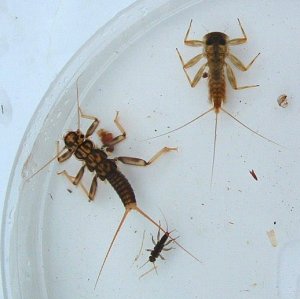
Stonefly larvae (2 tails) and mayfly larvae (3 tails) live in well oxygenated streams and are eaten by trout and juvenile salmon
Habitat fertility and the availability of food are key factors which determine the productivity of most fish populations in Wester Ross. Across much of Wester Ross, biological production is limited by the availability of nutrients, particularly phosphorus. Rainwater contains little phosphorus; the rocks underlying many of the river catchment areas of Wester Ross rivers yield very little phosphorus. The fertility of the land and waters that flow from the land is therefore largely determined by the ecosystem and by anthropogenic influences.
Much of Wester Ross has been heavily grazed by cattle, sheep and deer over hundreds of years. Removal of livestock and deer carcasses from catchment areas represents a net export of nutrients that under more natural ecosystem conditions have become available to aquatic life. Formerly there were also more people living in headwater areas, contributing to nutrient recycling in a semi-natural way. In terms of nutrient cycling, people, in the past, were a part of the ecosystem.
Baile mor Woodland
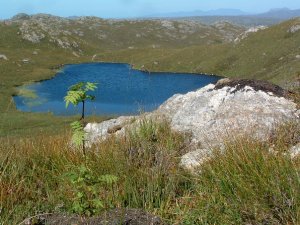
Trout lochs in the new woodland
By reducing grazing pressures, planting trees and applying fertilizer, soils are given a chance to recover. The largest WGS in Scotland, the Baile mor Woodland established by Gairloch Estate, is located between Gairloch and Loch Maree. There are trout lochs in the new woodland and these may become more productive as the trees become established.
Related Downloads
To download a file, right-click over it's name and choose Save Link/Target As...
-
WRFT Newsletter February 2025
This newsletter provides an introduction to the Salmon Stream Nutrient Restoration project, links to wild fish monitoring reports for salmon farm Environment Management Plans for 2024 and news about the search for spawning herring by Wester Ross in 2025. Thank you to all helpers and supporters!. Posted: 11/02/2025 (576KB) -
Malnourished salmon rivers? How important were salmon eggs as food for parr?
Presentation which considers the importance of salmon eggs as a food for pre-smolt salmon parr during the early winter. Is there a need to focus on ways of replacing this direct source of marine derived nutrition from adult salmon to juvenile salmon to help to mitigate for downward spiral of decline in numbers of adult salmon returning to oligotrophic rivers?. Posted: 01/05/2024 (7.42MB) -
Juvenile salmon production and nutrition in Wester Ross 2023
This report summarises the results of the juvenile salmon survey in Wester Ross in summer and early autumn, 2023. The report focusses on contrasting the size and biomass of juvenile salmon at different sites. There was much variation in growth; some sites had high densities of larger parr; at other sites parr were small and thin. Important missing food items for parr at some sites may include caddis fly larvae, terrestrial insects, and surplus washed-out salmon eggs which in some rivers may have been of crucial importance for pre-smolt salmon parr. Is it time to provide supplementary food for juvenile salmon in some rivers? . Posted: 05/02/2024 (1.65MB) -
Catchment vegetation, hummocks and wild salmon habitat resilience
Presentation by Peter Cunningham about project to protect salmon habitat in the Ullapool River focussing on restoration of vegetation and ecosystem fertility in the upper catchment (Glen Douchary) with examples of hummocks from other parts of Wester Ross and poster. From Catchment Vegetation Revival Workshop, Kinlochewe 26th April 2023. Posted: 02/05/2023 (23.52MB) -
Catchment vegetation workshop introduction and field trip report
Introduction to the WRFT Catchment Vegetation Revival meeting at Kinlochewe on 26th April 2023 and report from field trip to view hummocks and Donald McVean's fertilised plots by the Pony Path on Beinn Eighe NNR on 25th April 2023 by Dr Shraveena Venkatesh. Posted: 02/05/2023 (6.28MB) -
Nutrient Additions workshop presentation 6th February 2020
Presentation given by Peter Cunningham at the nutrient additions workshop at the Marine Scotland Freshwater laboratory on 6th February 2020. The presentation makes a case for phosphorus budgeting for Wester Ross to restore wild salmon populations and address problems associated with loss of phosphorus transfer and ecosystem malnourishment. . Posted: 28/02/2020 (9.55MB) -
Wester Ross Spring Spawning Herring Poster
This poster shows some of the life-cycle and ecology of herring which spawn close to Red Point to the south west of Loch Gairloch in March. The poster is still in draft form; comments welcome! . Posted: 29/03/2019 (912KB) -
Grazing, Trees and Trout illustrated report
This workshop, supported by The Woodland Trust, Forestry Commission Scotland and Wester Ross Fisheries Trust, focused on opportunities for integrating woodlands with other land management practices, including management of sheep and deer. . Posted: 27/07/2017 (1.15MB) -
Feed the Land by Peter Cunningham
This presentation considers the phosphorus deficit across much of Wester Ross and the need to understand ecosystem nutrition and ecosystem management requirements for grazing areas, croftlands, and for wildlife and fisheries management. . Posted: 03/07/2017 (17.02MB) -
Ecosystem Nutrition in Wester Ross Poster DRAFT1
The poster has been drafted with some ideas for ways to conserve and replenish phosphorus within Wester Ross. The file includes some explanation of the ideas presented. Comments welcome! . Posted: 18/11/2016 (987KB) -
Ecosystem fertility and (wild)life production in Wester Ross
Presentation given at Assynt Field Club meeting at Lochinver on 17th November 2016. After providing an explanation of ‘ecosystem fertility’, the presentation considers long term changes in ecosystem fertility: at Beinn Eighe NNR; of grazing areas around crofting townships; and of large areas of land managed for red deer. The presentation focuses on the need to develop practices that conserve and replenish phosphorus within Wester Ross. Opportunities for trials and demonstration projects to raise awareness of the importance of ecosystem nutrition and the need for managing fertility could be taken forward in collaboration with the Wester Ross Biosphere. . Posted: 18/11/2016 (25.30MB) -
Refertilising Wester Ross April 2016 Meeting Report
This report provides a summary of the three-day meeting in April 2016 which focussed on the human ecology of nutrient availability and the need to manage fertility in Wester Ross. The meeting was attended by over 40 participants, including representatives from a wide range of government agencies and NGOs. This report provides links to presentations and other information. Posted: 22/04/2016 (1.57MB) -
Report from Field excursion to Beinn Eighe NNR & Glen Torridon on 7th April 2016
This report is based on photos (GoPro video screenshots) from the excursion to sites by the Pony Path in Beinn Eighe NNR and sites around Loch an Iasgair (Torridon river headwaters) and includes a summary of much of the discussion. Posted: 22/04/2016 (6.75MB) -
Refertilising Wester Ross 7-9 April 2016 programme
Programme for three-day meeting to review issues relating to the fertility and productivity of land and freshwaters in Wester Ross, including speakers for the workshop on Friday 8th April in the Gairloch Community Hall. Posted: 28/03/2016 (810KB) -
Billier, Geoffrey (2014) A study of macro-invertebrates and the feeding behaviour of juvenile salmon in the Little Gruinard River SAC, 2014
Geoffrey Billier sampled macro-invertebrates and investigate the feeding behaviour of juvenile salmon in the Little Gruinard river, during a three-month internship for WRFT, as part of his studies at Ecole Nationale Sup?rieure Agronomique de Toulouse 'ENSAT'. This report provides much new information about the biodiversity of macro-invertebrates in the river, drift patterns (day & night) and the diet of salmon fry, parr and smolts. Posted: 30/09/2014 (3.22MB) -
Mamo, Sara (2013) Trophic Status and Ontogeny: An Analysis of Brown Trout (Salmo trutta, L.1758) Growth and Diet in Wester Ross, Scotland
This thesis by Middlesex University student Sara Mamo investigates the diet and growth of brown trout in Loch Coire na h-Airigh and Loch Feur, Wester Ross. Posted: 13/12/2013 (1.17MB) -
Dang, Vu H. (2013) Preliminary investigation of Aquatic Macro-Invertebrate Biodiversity in the Gairloch Hill Lochs, Wester-Ross Shire
This thesis by Middlesex University student Vu Dang investigates the aquatic macro-invertebrates biodiversity of lochs at varying altitudes, located in the Gairloch district, Wester Ross Shire, Scotland. Posted: 13/12/2013 (2.35MB) -
Refertilising Scotland part 2
Part 2 of presentation given by Peter Cunningham at the Reforesting Scotland Annual meeting at Torridon Village Hall on 25th September 2010. Posted: 27/09/2010 (15.03MB) -
Refertilising Scotland part 1
Part 1 of presentation given by Peter Cunningham at Reforesting Scotland Annual meeting at Torridon Village Hall on 25th September 2010. Posted: 27/09/2010 (25.99MB) -
March brown recording scheme
Buglife Scotland's March brown survey 2010. Posted: 04/03/2010 (178KB) -
Response to Beinn Eighe NNR Management Plan September 2009
Response from Peter Cunningham to Beinn Eighe NNR Management Plan. Posted: 02/10/2009 (174KB) -
Presentation by John Roberston (FWAG) on SRDP funding
Presentation by John Roberston (FWAG) on SRDP funding given at workshop on 26th January 2009. Click on the links in this presentation to explore related pages on the SRDP website. Posted: 04/02/2009 (457KB) -
Little Gruinard juvenile fish assessment 2006 report
This illustrated report presents the results of the 2006 WRFT Little Gruinard electro-fishing survey. Relationships between juvenile salmon abundance and habitat characteristics are discussed. The natural production of juvenile salmon in this Special Area of Conservation (SAC) for Atlantic salmon could be strengthened through restoring levels of natural fertility within the Little Gruinard catchment area. Posted: 22/09/2008 (964KB) -
Land Use and Salmon Smolt Production in Wester Ross
Presentation given by Peter Cunningham at the WRFT Ecosystem Fertility and Salmon Smolt Production Seminar on 30th November 2007. Describes growth of juvenile salmon in Wester Ross and how this relates to soil fertility and land management. Note large size of file!. Posted: 05/09/2008 (22.41MB) -
Ecosystem Fertility & Salmon Smolt Seminar November 2007
This report is a compliation of summaries of presentations at the WRFT Ecosystem Fertility Seminar in Gairloch on 30th November, 2007. Posted: 05/09/2008 (390KB)


