Sea trout
River Ewe and Loch Maree
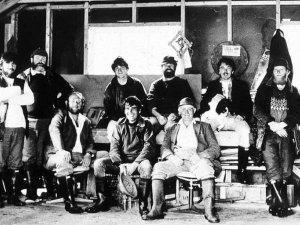
Loch Maree hotel ghillies in 1980s
The River Ewe - Loch Maree system was until the 1990s, one of the most famous sea trout systems in Scotland. During the 1970s and 1980s, the Loch Maree Hotel employed 9 ghillies through the fishing season (April to October). Hotels in Kinlochewe also employed several ghillies. The art of dapping was developed on the loch in the 1920s, and is still used today for fishing for trout and sea trout. With the collapse of the sea trout fishery, the majority of fisheries related jobs around Loch Maree were lost, and two up-market hotel establishments have become holiday lets with the additional loss of jobs.
For the Ewe system as a whole, the 5-year average catch of sea trout fell from 2,500 in 1982 to 800 in 2000. There has always been some difficulty in deciding what a sea trout is and what a finnock is. Many of the fish taken in 2007 in the River Ewe were early returned "sea trout" which had spent only a short 2nd summer at sea, returning prematurely with sea lice infestation.
A further indication of the collapse in the sea trout stock is the lack of larger sea trout taken in rod catches over recent years. Only a handful of fish of over 2lb were recorded in either the River Ewe or in Loch Maree in 2007. Further details of this fishery and its collapse can be found in Butler and Walker [1].
The Kanaird, Broom, Gruinard, Balgy (including Loch Damh) and Carron and many other rivers were also formerly noted for their sea trout fisheries with several hundred fish taken by rods in some years.
Dapping in Loch Maree
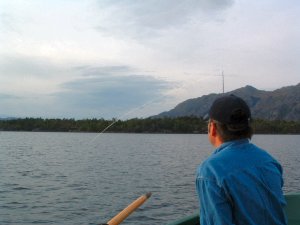
Dapping
Dapping is a special kind of "fly-fishing" using a long fishing rod, with a length of floss line to catch the wind, and a big bushy fly which is danced to and fro over the waves. The art of dapping was developed on the loch during the first half of the 20th century, and it remains popular with many anglers around the world. Both sea trout and brown trout - often quite large ones - readily chase the dapped fly, sometimes leaping clear of the water to catch it. It is likely that dapping flies are taken because of their resemblance to dragonflies or daddy-long legs both of which are common around the loch in summer and autumn. Spot the bushy fly...
References
- Butler, J.R.A. & Walker, A.F. (2006), Characteristics of the Sea Trout Salmo trutta Stock Collapse in the River Ewe (Wester Ross, Scotland), in 1988-2001. In Sea Trout: Biology, Conservation and Management. Published Online: 15 Nov 2007, Pages: 45-59
Related Downloads
To download a file, right-click over it's name and choose Save Link/Target As...
-
WRFT Newsletter February 2025
This newsletter provides an introduction to the Salmon Stream Nutrient Restoration project, links to wild fish monitoring reports for salmon farm Environment Management Plans for 2024 and news about the search for spawning herring by Wester Ross in 2025. Thank you to all helpers and supporters!. Posted: 11/02/2025 (576KB) -
Torridon Wild Fish Monitoring Report for 2024
Loch Torridon Sea trout and salmon monitoring report 2024 to inform the Loch Torridon Environment Management Plan for MOWI Scotland Ltd, Bakkafrost Scotland Ltd, Wester Ross Area District Salmon Fisheries Board, The Scottish Government and The Highland Council. Posted: 07/01/2025 (1.12MB) -
Applecross Wild Fish Monitoring report for 2024
Applecross Sea trout and salmon monitoring report 2024 to inform Loch Ainort, Caol Mor & Inner Sound EMP for MOWI Scotland Ltd., Wester Ross Area District Salmon Fisheries Board, The Scottish Government (in place of the Skye District Salmon Fisheries Board) and The Highland Council. Posted: 07/01/2025 (817KB) -
Wester Ross Fisheries Management Plan 2023 - 2028
This interactive plan provides information about pressures affecting wild salmon and sea trout populations in the Wester Ross area, and proposes a series of actions required to protect, support and strengthen wild fish populations in the Wester Ross area. Comments are welcome, please contact the WRFT Biologist at info@wrft.org.uk . Posted: 05/04/2024 (372KB) -
Rod catches of sea trout 2004 - 2022
Graphs for rod catches of sea trout in Wester Ross compiled from Scottish Government official catch statistics. Posted: 29/02/2024 (112KB) -
Finding Salmon and Sea trout around the Wester Ross MPA
This presentation by Peter Cunningham introduces the main wild salmon rivers that flow into the Wester Ross MPA and describes some of the issues, including infestation by sea lice from poorly regulated open cage salmon farms, which threaten wild salmon populations and sea trout within the Wester Ross area. Can the wild salmon populations around the Wester Ross MPA be given additional protection?. Posted: 27/10/2022 (11.01MB) -
Wester Ross: a stronghold for wild trout diversity? Presentation by Peter Cunningham 30th April 2019
Wester Ross remains a stronghold for wild brown trout some of which spend their entire lives in freshwater streams and lochs, others migrate to sea. This presentation, with illustrations of Wester Ross trout by Paul Vecsei, highlights some of the remarkable diversity within the area and some of the challenges for trout populations and fisheries. Posted: 28/05/2019 (11.17MB) -
Loch Maree Wild Trout population structure: first look by Vu Dang
Summary of the main findings of a genetic study of wild trout diversity in and around the Loch Maree catchment area with suggestions for conservation management by V Dang (MScRes. student) of Middlesex University. Posted: 28/05/2019 (3.61MB) -
Gairloch sea trout sample 19th April 2019
This file provides details of a sample of 30 sea trout taken using a sweep net in the Flowerdale estuary, Loch Gairloch on 19th April 2019. These fish carried high numbers of sea lice. . Posted: 22/04/2019 (536KB) -
Skye and Wester Ross Fisheries Trust Review February 2018
This review summarises the work of the Skye and Wester Ross Fisheries Trust during the period June 2016 to December 2018. Posted: 06/02/2018 (7.46MB) -
Sea trout sample, Loch Gairloch, 27th April 2017
Summary report from sweep netting of sea trout in Flowerdale estuary, Loch Gairloch on 27th April 2017. 32 sea trout were caught, with an estimated average lice burden of 98 lice per fish. . Posted: 01/05/2017 (1.85MB) -
Loch Torridon Sea trout report 2015
This report presents some of the results of investigations to gather information about sea trout around the Loch Torridon area in 2015 following reports of exceptionally high concentrations of parasitic sea lice (Lepeophtheirus salmonis) on salmon farms within the area during the first six months of 2015 . Sea trout were sampled by Wester Ross Fisheries Trust during the period May-July 2015 using sweep netting, rod and line and electro-fishing. In October and early November 2015 a fyke net trap was operated in a tributary of the River Torridon to learn more about the spawning population of trout within that river system. Posted: 05/01/2016 (7.75MB) -
Loch Maree Panorama by Ben Rushbrooke
When Ben was out surveying non-native invasive plants around the shores of Loch Maree in September 2015, he took a series of photographs from this less familiar viewpoint from which this composite has been put together. You can just about see from one end of the loch to the other, including several famous fishing beats. Thanks Ben!. Posted: 17/12/2015 (540KB) -
Costello, Scotland 2014: The problem for sea lice on salmonids: wild and farmed
Presentation given by Prof Mark Costello at the sea lice and sea trout management worskhop at Aultbea Village Hall, supported by WRFT and the Atlantic Salmon Trust, on 20th February 2014. The talk summarise knoweldge of louse biology, transmission to hosts, methods of control and the persistance of the problem. There is also a section at the end about Marine Reserves in New Zealand. Posted: 24/02/2014 (10.68MB) -
Problems for Sea trout in Wester Ross
This presentation has been tidied up from one given at the sea trout and sea lice management workshop at Aultbea Village hall on 20th February 2014. Data for sea lice and other factors affecting sea trout in Wester Ross are summarised. The presentation concludes with an outline for a Scottish Sea Trout Project aimed at improving our understanding of how different factors affect sea trout in different parts of Scotland. Posted: 21/02/2014 (6.57MB) -
WRFT Sea trout Monitoring review 2012
This report presents the results of sea trout and sea lice monitoring in 2012 within the WRFT area, and considers the occurrence of larger sea trout in Wester Ross and other parts of the West of Scotland. Posted: 12/04/2013 (6.05MB) -
WRFT Wild Trout Monitoring Report for 2011
This report presents the results of sea lice monitoring of sea trout in the sea around Wester Roiss and trout sampling in freshwater in 2011. Posted: 17/04/2012 (8.90MB) -
The Wild Trout of a Coastal Stream System in Wester Ross
Poster showing some of the wild trout and their prey and predators found in a coastal stream system in Wester Ross. Posted: 24/05/2011 (1.05MB) -
WRFT Sea trout monitoring report 2009 - spring 2011
Sea trout sampling in Wester Ross from 2009 to spring 2011. Includes results of sweep net sampling and links to scale reading catalogue. Posted: 11/04/2011 (1.95MB) -
Wester Ross Sea Trout Scale Catalogue April 2011
The document provides links to photographs of sea trout and their scales from the sea and river estuaries of Wester Ross. The catalogue will be updated in response to comments received. Posted: 05/04/2011 (989KB) -
WRFT sea lice monitoring Report 2007 - 2008
Following a review of sea lice biology and ecology and past studies from a local context, this report presents the results of sea lice monitoring of wild sea trout in the WRFT area in 2007 and 2008 and considers associations with salmon farming. Posted: 19/11/2009 (2.29MB)


